
How to measure stairs for a stair runner
To measure stairs for a runner, run a tape from the back of one tread, over the nose and down the riser to the next tread. That is one step. Multiply it by the number of steps, add the top riser and any landing, then measure the width of the stairs and decide how much bare stair you want showing either side.
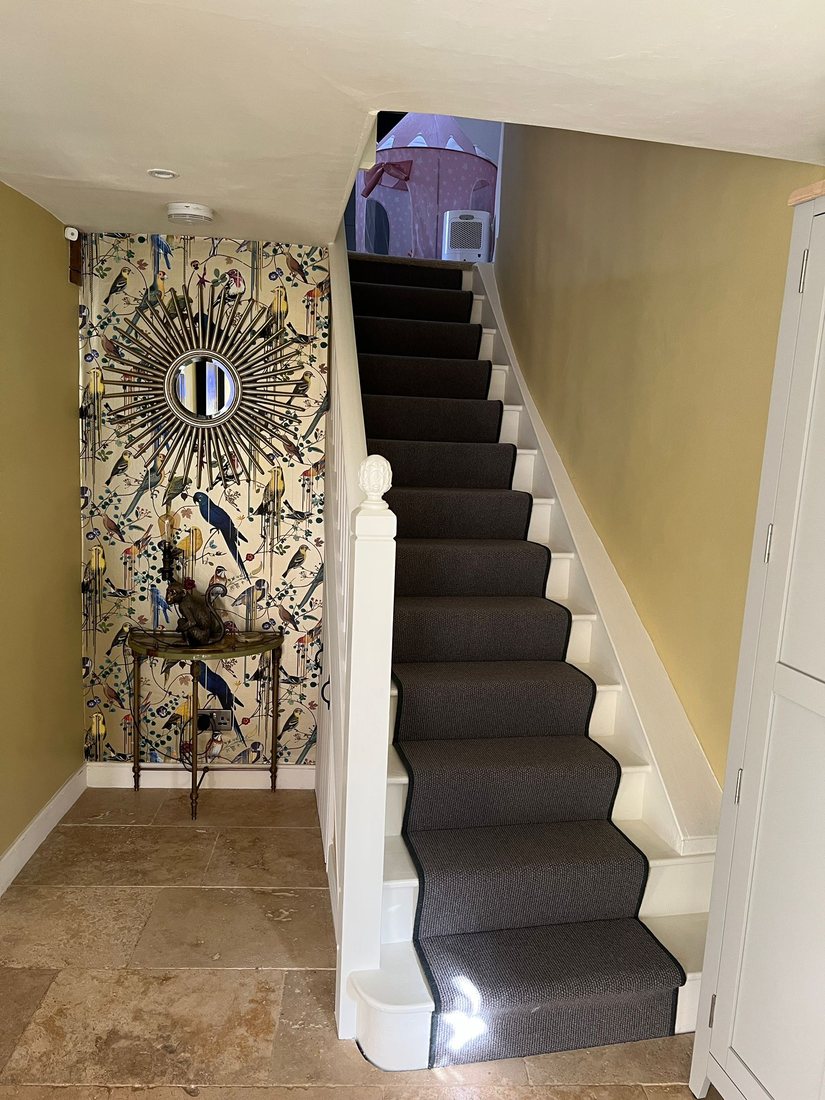
Send those figures and some photos to Eleanor and she'll make your stair runner to them. We're based in Melksham, working with customers across the UK.
Measure one step: the tread, the nose and the riser
The tread is the part you stand on, the nose is its front edge and the riser is the upright between one tread and the next. A runner covers all of it, so you measure along the surface, the way the carpet will lie.
Start where the tread meets the riser behind it. Take the tape forward over the tread and the nose, then down the riser to where it meets the tread below. Carpet retailer Tapi and runner maker Roger Oates both describe it this way, nose included. If your steps have a deep overhang or a rounded bullnose, follow the curve. Ideal Home's experts suggest a flexible tape, which bends round it far better than a rigid one.
Builders talk about the going and rise. In the building regulations (Approved Document K), the going is the depth of a tread less any overlap with the tread above, and the rise is the height between consecutive treads. The going leaves out the nose, so a figure from plans comes up short for a runner.
Count the steps and add it up
Measure two or three steps, not just one. Roger Oates says to check that all the treads and risers match, and if they don't, to measure each step and add the figures together. If they do match, multiply your one-step figure by the number of steps.
Then measure the last riser at the top, up to the landing, and add it on. Roger Oates also adds 50cm per flight for tolerance, while other guides just say a little extra. Tapi's advice is to write the measurements down exactly as you take them and add any allowance afterwards. It's also the clearest way to send them to whoever makes your runner.
Decide where the runner starts and stops
At the top, the runner can stop under the nose of the landing or carry on across it. Stair Rods Direct says that if it carries on, it should go at least 300mm back from the landing nose, because anything shorter is a trip hazard.
At the bottom, you can stop on the last tread, run down over the bottom riser or carry on onto the hall floor. Measure to wherever you choose.
Choose the runner width
Measure the width of the stairs at a few points up the flight and note each one. Tapi takes several measurements wall to wall because walls aren't always parallel. Take your runner width away from the stair width and halve it to get the gap on each side.
Ideal Home's experts say about 10cm either side is usual, with more if you have a wooden staircase worth showing off. Roger Oates recommends at least 5cm. Stair Rods Direct warns that a very narrow runner gives a tightrope look, and a very wide one hides the staircase.
Ready-made runners come in set widths: Roger Oates weaves 60cm, 70cm and 85cm. A made to measure runner doesn't have to match one of those, so you can pick the gap you like and work back from it. Eleanor is happy to talk it through before you commit to anything.
Measuring a landing
Measure the length and width of the landing separately, and add the length to your total if the runner continues across it. On a half landing, where the stairs turn partway up, Tapi measures across the width, then along the length including the drop over the step to the next tread.
The landing doesn't have to be one piece with the stairs. Roger Oates lists a fitted landing runner, wall to wall carpet, a loose runner or a rug as the usual choices. We make hallway runners cut to the exact length of your hall or landing, so a separate landing runner in the same carpet and edge is worth asking about.
Winders, turning stairs and curved stairs
Winders are the wedge-shaped steps where a staircase turns. Each one is a slightly different size, so Tapi and Homebuilding both say to measure them one at a time. Measure the length as you would a straight step. For the width, Tapi goes from the inner corner on the narrow side to the furthest point on the wide side, and Roger Oates measures winding steps along the outside edge. Roger Oates also says a good fitter is essential on winders.
With curved or turning stairs, send photos of the whole staircase along with your measurements. Eleanor will talk through what's possible for your stairs.
A measuring checklist to print
- Get a flexible tape measure and sketch the stairs.
- Count the steps from bottom to top. Note any winders or a half landing.
- Measure one step from the back of the tread, over the nose, to the bottom of the riser.
- Measure two or three more steps. If they differ, measure every step.
- Measure the top riser up to the landing.
- Decide where the runner starts and stops. Measure the landing or hall floor if it carries on.
- Measure each winder separately.
- Measure the stair width at a few points up the flight.
- Choose how much bare stair to show either side and work out the runner width.
- Photograph the whole staircase from the bottom and the top, plus any turn or landing.
- Write the measurements down as you took them, and note anything you've added.
Sending your measurements to Eleanor
Ring Eleanor on 07921 671108 or use the contact form and choose "Stair runner". Send your measurements and photos, plus a photo of your carpet if you're using your own. A runner can be made from new carpet or from suitable carpet you already have, and your measurements will show whether a piece you have is big enough.
We'll agree the size and the edge with you and send tape samples so you can see them against your carpet at home. The carpet binding and whipping page explains the two edges, and there are finished runners in the gallery.
If you're further away, call Eleanor and she'll talk you through getting your carpet to us and back. If you'd like the runner fitted too, ask about fitting when you get in touch.
Updated 2 November 2026.
Common questions
Anything else, just ask. Eleanor is happy to talk through your options before you commit to anything.
Are stair runners a standard size?
Ready-made runners usually come in set widths, such as Roger Oates' 60cm, 70cm and 85cm. A made to measure runner is made to your stairs.
How much stair should show either side of a runner?
Ideal Home's experts say about 10cm is usual, and Roger Oates recommends at least 5cm. Take the runner width from the stair width and halve it.
How long a runner do I need for 13 stairs?
Measure one step, nose included, multiply by 13, then add the top riser and any landing.
Do you fit stair runners?
Ask Eleanor about fitting when you call or send your details.
I'm not near Melksham. Can you still make my runner?
Yes. We're based in Melksham, working with customers across the UK. Call Eleanor and she'll talk you through getting your carpet to us and back.
Get a quote
Tell us what you have and what you would like it to become. Call Eleanor on 07921 671108, or send us a message.
Request a quote